
Wondering how does microneedling work to improve skin texture? Discover the science of collagen induction therapy, micro-injuries, and natural skin repair.
This comprehensive guide explores the physiological mechanisms behind microneedling, also known as collagen induction therapy. It details how controlled, microscopic punctures trigger the body’s innate healing response, leading to the synthesis of new collagen and elastin fibers. Written from the perspective of a nurse-led clinic, this resource explains the transition from micro-injury to visible skin renewal, helping patients understand exactly what happens beneath the surface during and after a professional treatment session.
Introduction
The pursuit of smoother, firmer, and healthier-looking skin often leads individuals to explore advanced cosmetic procedures. Among the most widely researched and clinically trusted methods available today is professional microneedling. Also recognized within medical aesthetics as collagen induction therapy, this treatment has become a cornerstone of non-surgical skin rejuvenation.
While the concept of intentionally making tiny punctures in the skin may sound counterintuitive at first glance, the underlying biological science is remarkably elegant. The human body possesses an intricate, highly efficient system for self-repair. Microneedling taps directly into this innate survival mechanism, directing its power toward cosmetic enhancement and tissue structural improvement.
For residents across Northern Ireland seeking to understand their aesthetic options, clarity is essential. When considering any clinical intervention, knowing exactly what is happening beneath the epidermal surface allows you to make informed, confident choices regarding your personal skincare journey. This article will break down the precise cellular activities, structural shifts, and physiological phases that answer the fundamental question: how does microneedling work?
The Core Mechanism: What is Microneedling?
To understand how does microneedling work, one must first look at the basic anatomy of the skin. The skin is composed of multiple layers, primarily the thin outer epidermis and the deeper, structurally rich dermis. The dermis acts as the scaffolding of the face, housing the vital network of blood vessels, nerves, hair follicles, and, most importantly, structural proteins.
|                   Epidermis                           |  <- Temporary Micro-channels

|                   Dermis                                        |   <- Fibroblast Activation
|  (Collagen & Elastin Matrix)                          |   <- Growth Factor Release
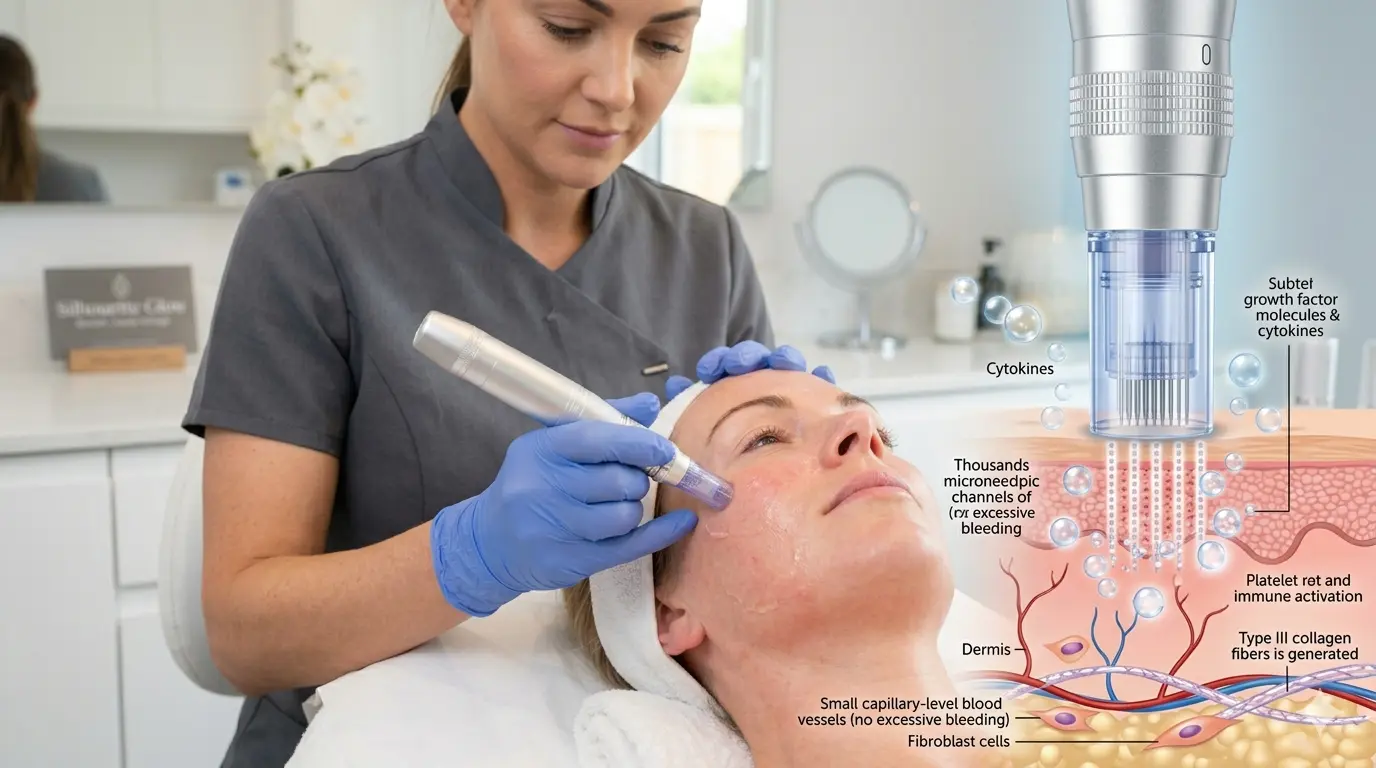
During a professional microneedling treatment, a specialized device equipped with sterile, ultra-fine medical needles is gently guided across the target areas. These needles puncture the skin vertically, creating thousands of microscopic channels.
These punctures are explicitly referred to in clinical literature as micro-injuries. The term injury is used technically, but these channels are highly controlled, remarkably precise, and entirely intentional. They are deep enough to penetrate into the upper layers of the dermis to trigger a cellular response, yet they are small enough that they do not cause actual tissue loss, thermal damage, or permanent scarring.
The true brilliance of this mechanism lies in the preservation of the skin barrier. Because the needles are exceptionally fine and create clean, vertical entry points, the surrounding tissue remains largely intact. The skin recognizes these tiny entry points as micro-wounds that require immediate attention. Consequently, the body initiates a localized healing response, releasing an influx of growth factors and signaling molecules that kickstart natural skin repair.
If you are completely new to this concept and wish to read an foundational overview of the treatment itself, you may find it helpful to explore our companion article, What Is Microneedling? A Complete Beginner’s Guide.
The Three Phases of the Skin’s Healing Cascade
The journey from a clinical micro-injury to healthier-looking skin is not instantaneous. It relies on a highly regulated, chronological biological sequence known as the wound healing cascade. This cascade is divided into three distinct, overlapping phases, each playing a critical role in the overall success of the skin renewal process.
[Phase 1: Inflammation]  --->  [Phase 2: Proliferation]  --->  [Phase 3: Remodeling]
(Days 1 - 3)                               (Days 3 - 5)                            (Day 5 - Months)
Platelets & Neutrophils            Fibroblasts & New Vessels         Collagen Realignment
Phase 1: The Inflammatory Phase (Days 1 to 3)
The moment the microneedles penetrate the dermis, the inflammatory phase begins. This is the body’s immediate emergency response to any breach of physical tissue.
-
Platelet Activation: The minor puncturing of microscopic blood vessels causes platelets to form a temporary cluster, releasing intracellular signaling molecules called cytokines and growth factors.
-
Immune Cell Recruitment: Immune cells, specifically neutrophils and macrophages, are promptly directed to the area. Their primary responsibility is to clear away any cellular debris and neutralize any potential pathogens, ensuring a clean environment for subsequent tissue synthesis.
-
Vasodilation: Blood vessels in the immediate vicinity dilate, increasing localized blood flow to deliver essential nutrients and oxygen. This biological activity explains the mild erythema, or redness, typically observed immediately following a session.
Phase 2: The Proliferation Phase (Days 3 to 5)
Once the area is stabilized and cleared by the immune system, the skin transitions smoothly into the proliferative phase, which focuses heavily on rebuilding the temporary structural bridge.
-
Fibroblast Migration: Specialized cells located within the dermis, known as fibroblasts, are drawn to the micro-channels. Fibroblasts are the principal structural factories of the skin.
-
Angiogenesis: The body begins creating new, microscopic capillaries. This formation of fresh blood vessels ensures that the newly developing tissue receives a continuous, rich supply of oxygen and essential micronutrients.
-
Granulation Tissue Formation: Fibroblasts rapidly produce an extracellular matrix composed primarily of Type III collagen, early elastin proteins, and glycosaminoglycans. This acts as a framework to close the microscopic physical gaps created by the needles.
Phase 3: The Tissue Remodeling Phase (Day 5 to Months Later)
The final phase is where the most significant, long-lasting visual improvements to skin texture and firmness occur. Remodeling is a slow, methodical process that can continue for several months after a single professional treatment.
-
Collagen Maturation: The temporary Type III collagen, which is somewhat disorganized and delicate, is systematically replaced by Type I collagen. Type I collagen is significantly stronger, thicker, and organized into tightly woven parallel bundles.
-
Tissue Realignment: The newly synthesized collagen and elastin fibers align themselves along the natural tension lines of the skin.
-
Skin Tightening and Compacting: As the matrix tightens and matures, the overall density of the dermis increases. This slow structural compacting leads to a smoother surface, a reduction in the appearance of fine structural irregularities, and a subtle improvement in the skin’s natural resilience.
Key Structural Proteins: The Roles of Collagen and Elastin
To fully appreciate the science of skin rejuvenation, it helps to understand why we focus so heavily on collagen stimulation. These proteins dictate how our skin behaves, ages, and reflects light.
Collagen: The Architecture of Firmness
Collagen is the most abundant protein in the human body, acting as the literal glue that holds our tissues together. In the dermis, collagen fibers form a dense, supportive mesh network. This network provides the structural tensile strength that keeps skin looking plump, taut, and firm.
As we progress through adulthood, natural collagen production naturally declines by approximately one percent each year. Environmental stressors, such as UV exposure from the sun and lifestyle factors, can accelerate this depletion. When the collagen matrix degrades, the skin loses its underlying support, leading to the gradual formation of fine lines, wrinkles, and structural laxity.
By inducing controlled micro-injuries, microneedling tricks the skin into thinking it must build new structural support, effectively reversing the passive degradation cycle through localized collagen induction therapy.
Elastin: The Secret to Snap-Back Elasticity
While collagen provides the strength, elastin provides the flexibility. True to its name, elastin is a highly elastic protein that allows the skin to stretch, bend, and immediately snap back into its original position when compressed or pulled.
A lack of healthy elastin fibers results in skin that appears crepey, thin, and slow to recover from movement. The natural skin repair process initiated by professional microneedling doesn’t just focus on collagen; it simultaneously promotes the expression of elastin genes within the fibroblasts, helping the skin regain its youthful springiness and structural flexibility.
Why Professional Microneedling Differs from At-Home Derma Rolling
With the rise of DIY beauty trends, at-home derma rollers have become widely accessible. However, from a clinical, anatomical, and safety standpoint, at-home rolling and professional microneedling treatments are fundamentally different procedures with highly contrasting mechanisms of action.
| Feature | At-Home Derma Rolling | Professional Microneedling |
| Needle Entry Angle | Curved / Angled (can slice tissue) | Strictly Vertical (clean, precise channels) |
| Depth Control | Fixed, very shallow (usually 0.2mm – 0.25mm) | Adjustable (0.25mm up to 2.5mm or deeper) |
| Primary Mechanism | Superficial product absorption enhancement | Deep dermal remodeling & collagen induction |
| Sterilization Standards | Plastic components, repeatedly washed at home | Single-use, medically sterile, disposable tips |
| Risk Profile | High risk of micro-tearing, cross-contamination, and scarring | Low risk when performed by a qualified clinical professional |
The Issue with Angled Entry
At-home derma rollers utilize a rolling wheel mechanism. As the wheel moves across the face, the needles enter the skin at an angle and exit at an angle. This curved path can create a slicing effect, resulting in micro-tears rather than clean, vertical micro-channels. Micro-tears cause unnecessary trauma to the epidermis, increasing the risk of hyperpigmentation, irritation, and tracking scars.
In contrast, professional automated pens utilize a rapid, mechanical motor to drive the needles vertically into the skin at high speeds. The device moves in a precise up-and-down motion while gliding smoothly over the surface. This ensures that the entry and exit points are completely straight, maximizing the depth efficacy while minimizing surface trauma.
At-Home Roller (Angled Entry/Exit)       Professional Pen (Vertical Entry/Exit)
        \     /                                        |     ^
         \   /                                         |     |
----------V-V---------- Skin Surface ----------V-----|----------
Customisable Depth for Specific Indications
Skin thickness varies drastically across different areas of the face. The skin surrounding the eyes and across the bridge of the nose is incredibly delicate and thin, whereas the skin on the cheeks and jawline is significantly thicker.
An at-home roller features a single, unchangeable needle length, usually restricted to a very shallow depth for consumer safety. Professional microneedling allows the practitioner to dynamically adjust the needle depth throughout the session, ranging from a superficial 0.25mm up to deeper settings depending on individual circumstances and the precise structural profile of the target area. This customisation ensures that the needles reach the exact layer of the dermis where fibroblast cells reside, without causing unnecessary discomfort or risk in thinner anatomical zones.
What Happens to Your Skin During a Treatment Session?
Walking into an aesthetics clinic for the first time can feel daunting if you are unsure of what to expect from the procedure. While you can find comprehensive breakdowns regarding specific details like comfort levels in our guide, Does Microneedling Hurt?, understanding the procedural flow clarifies the scientific nature of the treatment.
-
Clinical Assessment: Every successful intervention begins with a thorough evaluation of the skin. A qualified practitioner examines your skin type, hydration levels, and structural goals to determine if you are a suitable candidate for collagen stimulation.
-
Sanitization and Preparation: The treatment area is meticulously cleansed and sanitized using clinical-grade antiseptic solutions to remove surface lipids, cosmetics, and microbes, ensuring a completely sterile environment for the micro-channels.
-
The Microneedling Glide: A sterile, single-use needle cartridge is attached to the professional device. The practitioner selects the optimal depth settings for each anatomical zone. A specialized gliding medium, often containing high-molecular-weight hyaluronic acid, is applied to the skin. This fluid acts as both a lubricant for the device and a topical boost that penetrates the newly opened channels to support early hydration.
-
Controlled Coverage: The device is methodically moved across the skin in a structured grid pattern. The practitioner manages pressure and speed to ensure uniform micro-channel density across the targeted treatment areas.
-
Post-Treatment Protection: Once the desired endpoint (a uniform, mild pinkness or light erythema) is reached, the skin is gently wiped clean. A soothing, protective barrier cream or specialized serum may be applied to support the initial phase of the inflammatory cascade.
To learn more about the steps required to keep these microscopic channels clean and safe immediately following your session, please refer to our comprehensive resource, Microneedling Aftercare.
Factors Influencing the Mechanism of Action
The physiological success of a microneedling treatment is not a guaranteed constant; it is highly dependent on a collection of internal and external variables. Understanding these factors highlights why a personalized, professional approach is so critical to achieving healthier-looking skin.
Cellular Health and Nutrition
Because microneedling relies entirely on your body’s ability to manufacture new proteins, your baseline cellular health dictates the final quality of the tissue remodeling. The body requires adequate building blocks to synthesize high-quality collagen and elastin. Factors such as a balanced diet rich in Vitamin C, amino acids, and zinc, alongside proper systemic hydration, provide the necessary raw materials for fibroblasts to perform efficiently during the proliferation phase.
Age and Baseline Regenerative Capacity
While collagen induction therapy can successfully stimulate cellular activity across a vast age demographic, a person’s chronological age naturally influences the speed and volume of the healing cascade. Younger skin typically possesses a more robust population of active fibroblasts and a rapid cellular turnover rate. Mature skin may take longer to navigate the tissue remodeling phase, meaning the gradual tightening and smoothing effects may manifest more subtly and over a slightly extended period.
Treatment Consistency and Spacing
A single session of microneedling will initiate the healing cascade, but a single cycle is rarely sufficient to completely transform deeply rooted structural skin concerns. Collagen remodeling is an additive process.
However, spacing treatments too closely together can disrupt the delicate tissue remodeling phase, cutting short the natural maturation of Type I collagen. Allowing the skin ample time to fully progress through its biological cycles between appointments ensures structural integrity is maintained. For a detailed breakdown of what this healing progression looks like day by day, you can consult our informative guide on the Microneedling Recovery Timeline.
Practitioner Expertise and Clinic Standards
The precision with which the micro-injuries are delivered drastically alters the body’s subsequent biological response. A highly trained practitioner understands the subtle nuances of skin resistance, tissue mapping, and depth adjustments. Operating within a nurse-led clinic, such as Silhouette Glow in Richhill, County Armagh, guarantees that safety, sterilization protocols, and anatomical knowledge are prioritized, creating a controlled environment where the skin can heal optimally.
Frequently Asked Questions
1. How does microneedling work to improve skin texture?
Microneedling creates thousands of precise, vertical micro-channels in the skin. These tiny punctures trigger the body’s natural wound healing response, prompting fibroblasts to synthesize fresh collagen and elastin. As this new tissue matures during the remodeling phase, the skin naturally becomes denser, smoother, and more refined in texture.
2. What is collagen induction therapy?
Collagen induction therapy is simply the clinical, medical term for microneedling. It refers specifically to the procedure’s primary mechanism of action: intentionally inducing a controlled healing cascade to stimulate the production of structural collagen within the dermal layers of the skin.
3. Does microneedling actually damage the skin?
It causes controlled micro-injuries, but it does not cause permanent damage when performed correctly by a professional. The punctures are microscopic and vertical, leaving the surrounding skin tissue intact. This triggers a beneficial healing response without compromising or destroying the long-term integrity of the skin barrier.
4. How long does it take to see results from the collagen stimulation?
While the initial inflammatory phase happens within the first few days, the true structural remodeling of collagen is a slow process. Subtle changes in skin texture may begin to appear within a few weeks, but the peak benefits of new Type I collagen synthesis typically manifest between two to three months post-treatment.
5. Can microneedling be performed on all skin types?
Because microneedling is a mechanical treatment that does not introduce thermal heat or harsh chemicals, it is generally considered safe and versatile for a wide range of skin types and tones. However, a comprehensive clinical evaluation by a qualified practitioner is always required to confirm suitability based on individual circumstances.
6. What is the difference between microneedling and chemical peels?
Microneedling uses physical micro-needles to stimulate deep structural repair within the dermis via a mechanical healing cascade. Chemical peels utilize specialized acid solutions to exfoliate the top layers of the epidermis, promoting rapid cellular turnover from the outside in. For an in-depth comparison of these two modalities, please view our guide, Microneedling vs Chemical Peels.
7. How deep do the needles go during a professional treatment?
The needle depth is entirely customizable, usually ranging from 0.25mm up to 2.5mm depending on the specific area of the face and the skin concern being addressed. Thinner areas like the forehead require shallow settings, while thicker areas like the cheeks allow for deeper dermal penetration.
8. What should I avoid immediately after a session to ensure proper healing?
To protect the open micro-channels from irritation or infection, you should avoid touching your face, applying cosmetics, heavy sweating, direct sun exposure, and active skincare ingredients like retinoids or exfoliating acids for the initial period recommended by your practitioner.
9. Can I achieve the same results with an at-home derma roller?
No. At-home derma rollers feature fixed, very shallow needle lengths that enter the skin at an angle, which can cause surface micro-tears. Professional treatments use automated, vertical needles with adjustable medical-grade depth control, enabling safe, deep dermal remodeling that at-home devices cannot achieve.
10. How many microneedling treatments are typically required?
The total number of sessions depends heavily on individual skin goals and baseline conditions. While some individuals notice a pleasant improvement after a single session, a structured series of treatments spaced several weeks apart is frequently recommended for optimal, long-term tissue remodeling.
11. What does the skin look like immediately after a session?
Due to increased blood flow and vasodilation during the initial inflammatory phase, the skin will generally appear flushed or moderately red, similar to a mild sunburn. This is a completely normal physiological response and typically subsides within a few days as the proliferation phase takes over.
12. Does the procedure cause permanent scarring?
When performed by a trained professional using high-quality, vertical needle devices in a sterile clinic environment, the risk of scarring is exceptionally low. The micro-channels are highly controlled and designed to heal completely clean without leaving permanent structural marks.
13. Can microneedling help with fine lines and wrinkles?
Yes. By stimulating the fibroblasts to produce new Type I collagen and elastin, the underlying structural matrix of the skin is reinforced. As this matrix becomes denser and more resilient during the tissue remodeling phase, fine lines and superficial wrinkles can appear naturally softened.
14. Is there any downtime associated with professional microneedling?
Downtime is generally minimal, but it varies from person to person. Most individuals experience mild redness, slight swelling, and minor skin dryness for a few days post-treatment while the skin navigates its natural repair cascade. To learn more about this progression, you can review our Microneedling Recovery Timeline.
15. Where can I find professional microneedling treatments in Northern Ireland?
Professional, nurse-led microneedling treatments are available at dedicated medical aesthetics clinics, such as Silhouette Glow, located in Richhill, County Armagh. Seeking treatment from a regulated nursing professional ensures the highest standards of safety, hygiene, and anatomical care throughout your skin rejuvenation journey.
Final Thoughts
The human skin is a remarkably dynamic organ, possessing a profound capability to regenerate and fortify itself when properly stimulated. Professional microneedling masterfully harnesses this biological potential, transforming the concept of controlled micro-injury into a highly predictable, scientifically validated method for skin renewal.
By understanding that the process relies on a meticulous three-phase healing cascade, you can appreciate why true, structural skin rejuvenation takes time. The gradual synthesis of high-quality Type I collagen and elastin provides a genuine, internal pathway toward achieving a smoother, more resilient, and healthier-looking skin profile.
When undertaking any medical aesthetic treatment, the importance of clinical oversight cannot be overstated. Entrusting your skincare journey to an experienced, qualified professional guarantees that the physiological mechanisms are executed with the exact precision, safety margins, and tailored depth parameters required for your specific skin anatomy.
If you’re considering professional microneedling and would like personalized advice based on your skin concerns and goals, booking a consultation with a qualified practitioner is the best place to start.
At Silhouette Glow, located within the Bramley Business Centre in Richhill, County Armagh, we prioritize an educational, patient-centered approach to skin health. During an initial consultation, we can evaluate your baseline skin condition, discuss your structural objectives, and map out a tailored care plan designed to support your skin’s natural regenerative journey safely and effectively.
To discover more about our clinic’s philosophy, feel free to read About Vaida, or take the next step in your skincare journey by clicking below to arrange your one-on-one professional assessment. You can also read client reviews and see our latest updates through our Google Business Profile.