
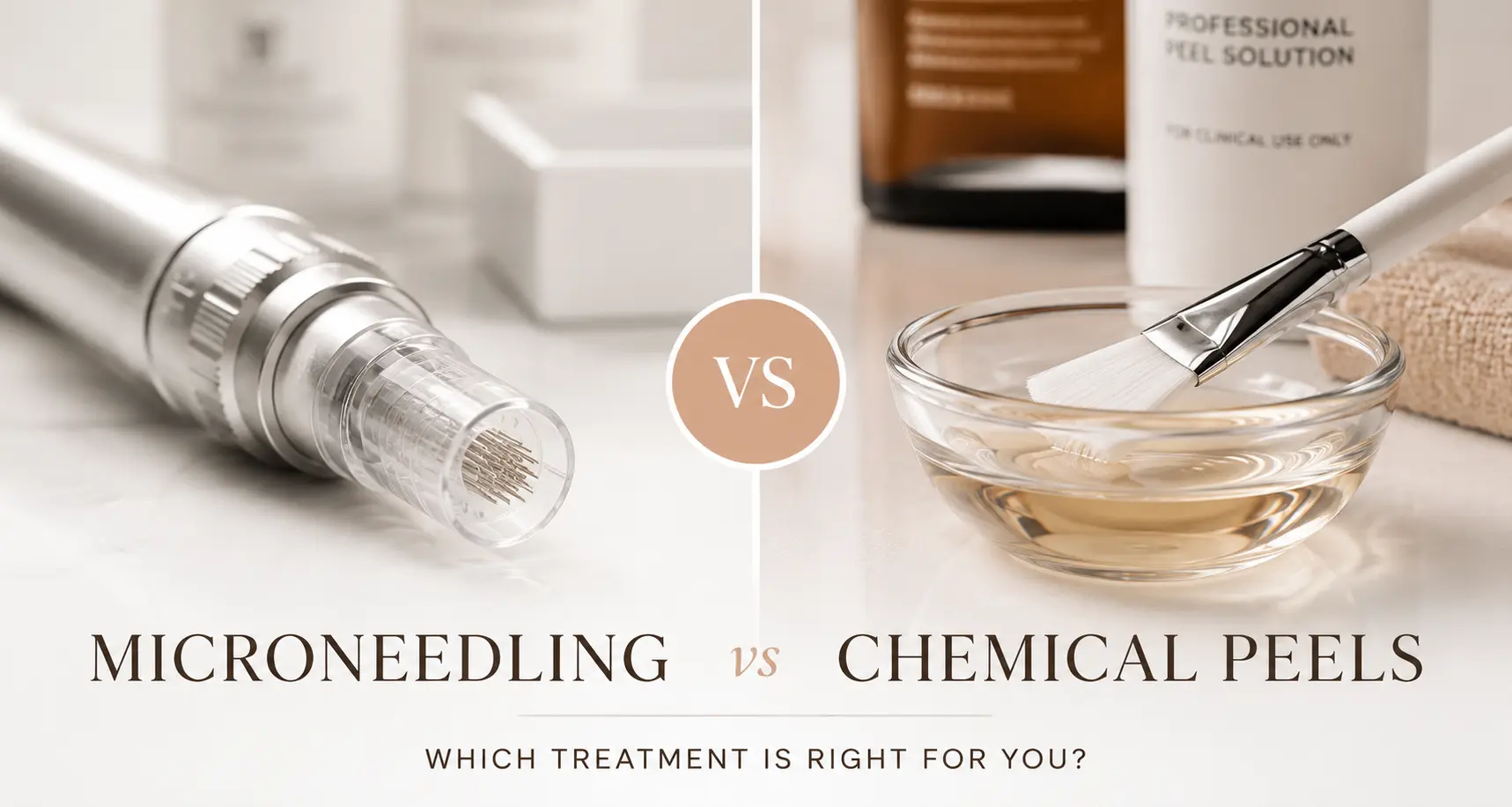
Choosing the ideal path to skin rejuvenation requires an understanding of how different clinical modalities interact with your tissue architecture. This comparative guide analyzes Microneedling vs Chemical Peels, breaking down the fundamental differences between mechanical collagen induction therapy and chemical exfoliation. Written from a nurse-led perspective, this article evaluates how each procedure targets specific concerns—such as scarring, fine lines, and hyperpigmentation—helping patients make an informed choice tailored to their unique skin barrier and comfort preferences.
Introduction
In the pursuit of smoother, firmer, and distinctly healthier-looking skin, modern clinical aesthetics offers an impressive suite of non-surgical solutions. Two of the most time-tested, popular, and scientifically validated treatments available today are professional microneedling and advanced chemical peels.
Both modalities are celebrated globally for their capacity to accelerate skin renewal, fade stubborn imperfections, and reveal a radiant complexion. However, because both procedures achieve dramatic skin rejuvenation, individuals often find themselves caught in a common dilemma: microneedling vs chemical peels—which one is truly right for my skin?
Stepping into the world of clinical aesthetics can occasionally feel overwhelming due to conflicting information online. Making the wrong choice can lead to underwhelming results, or worse, put unnecessary stress on your skin barrier.
For clients across Northern Ireland seeking clear, honest, and medically sound guidance, making an informed choice is the foundation of a successful skincare journey. This comprehensive guide will contrast these two powerhouse treatments, analyzing their biological mechanisms, comparing their target indications, and helping you identify the exact path that aligns with your personal skin goals.
The Core Philosophy: How Each Modality Operates
While microneedling and chemical peels share the ultimate goal of driving skin renewal, they approach the task from completely opposite biological directions. One works mechanically from the inside out, while the other works chemically from the outside in.
| Microneedling (Inside Out) | Chemical Peel (Outside In) |
|---|---|
| Stimulates Dermis ↑ | Dissolves Epidermis ↓ |
| Triggers Deep Collagen | Removes Dead Surface Cells |
Microneedling: Mechanical Collagen Induction
Professional microneedling, also known as collagen induction therapy, is a mechanical treatment. Utilizing an advanced, automated medical pen equipped with sterile, micro-fine needles, the practitioner creates thousands of vertical, microscopic channels directly into the skin’s surface.
These micro-channels do not remove tissue; instead, they act as tiny, controlled alarms that wake up the body’s natural skin repair mechanisms. This response triggers fibroblast cells deep in the dermis to manufacture a rich matrix of fresh collagen and elastin, structurally rebuilding the skin from within.
If you want a deeper breakdown of the biological science behind how these micro-channels heal, feel free to read our foundational article, How Does Microneedling Work? The Science Behind Healthier-Looking Skin.
Chemical Peels: Controlled Chemical Exfoliation
An advanced chemical peel, on the other hand, is a chemical exfoliation process. During this treatment, a carefully calibrated acid solution (such as Glycolic, Salicylic, Lactic, or Mandelic acid) is meticulously applied to the skin.
Rather than puncturing the skin, the solution works by breaking down the intercellular “glue” that binds dead, damaged skin cells to the epidermis. By dissolving this outer layer of debris in a controlled manner, a peel forces the skin to shed its dull surface, instantly exposing the fresh, luminous, unblemished skin cells waiting underneath.
Comparing the Clinical Indications: Which Concerns Solve What?
Because their biological pathways differ, microneedling and chemical peels naturally excel at treating different types of skin concerns. Identifying whether your primary issue is structural (texture) or surface-level (tone) is the first step in making your choice.
| Excels at Microneedling | Excels at Chemical Peels |
|---|---|
| Deep, pitted acne scars | Superficial hyperpigmentation |
| Fine lines and deep wrinkles | Active acne and congestion |
| Skin laxity and loss of firmness | Dull, dehydrated skin texture |
| Textural irregularities | Melasma and sun damage spots |
When to Choose Microneedling (The Texture Specialist)
If your primary skin frustrations revolve around structural defects in the skin matrix, microneedling is typically the superior option. Because it penetrates deep into the dermis, it is the gold standard for treating deep, pitted acne scars, structural fine lines, surgical scars, and overall loss of skin elasticity. A chemical peel cannot remodel deep scar tissue or build structural dermal thickness in the same way that targeted mechanical needling can.
To view the complete journey a beginner takes when initializing this texture-transforming option, read our guide, What Is Microneedling? A Complete Beginner’s Guide.
When to Choose Chemical Peels (The Tone and Clarity Specialist)
If your goals are centered around refining the outer surface color, tone, and immediate clarity of your face, chemical peels are hard to beat. Peels are exceptionally efficient at breaking up stubborn surface pigmentation, lifting sun damage, balancing uneven skin tones, and managing melasma.
Additionally, because specific acids like Salicylic acid are oil-soluble, peels can dive deep into pores to dissolve excess sebum and debris, making them incredibly effective at clearing active acne, blackheads, and superficial congestion.
Downtime and Recovery: What to Expect Post-Treatment
For busy individuals juggling professional and social commitments, understanding post-procedure downtime is a key factor in selecting an aesthetic procedure.
The Microneedling Downtime Profile
Following a professional microneedling treatment, your skin moves through a highly predictable, day-by-day healing sequence. For the first 24 to 48 hours, the face looks moderately flushed and feels warm and tight, very similar to a moderate sunburn. Between days 3 and 5, you may experience light flaking or sandpapery dryness as the skin sheds old cells. Visible recovery is usually completely wrapped up within 5 days.
To plan your calendar around this process with total accuracy, explore our dedicated Microneedling Recovery Timeline.
The Chemical Peel Downtime Profile
The recovery timeline for a chemical peel depends entirely on the depth of the peel selected (superficial, medium, or deep). With a superficial peel, downtime is virtually non-existent, presenting only as mild brightness and slight tightness.
With a medium-depth professional peel, your skin will typically look normal for the first 48 hours, after which the acid’s exfoliating effect takes hold. The skin will begin to literally peel or sheet away in visible patches over the course of 3 to 7 days. This requires diligent hydration and care to protect the vulnerable skin barrier beneath.
Regardless of your choice, safeguarding your skin with a custom-tailored post-treatment routine is non-negotiable. Review our complete guide to Microneedling Aftercare to see the level of discipline required to protect a recovering skin barrier.
Sensation Profiles: Physical Vibration vs Chemical Warmth
How a treatment feels during the active clinical session is a very common source of anxiety for many clients. Fortunately, both options are highly manageable in an expert setting.
-
The Feel of Microneedling: Many people assume needling causes sharp pain, but when performed with a medical-grade automated device, the primary feeling is a fast, mechanical vibration accompanied by a prickly, scratchy sensation as it glides across the skin. To understand how comfort parameters are managed systematically throughout this treatment, see our deep-dive article, Does Microneedling Hurt? What to Honestly Expect From Your Treatment.
-
The Feel of a Chemical Peel: A chemical peel involves no mechanical contact or needles. Instead, as the active acid solution interacts with the epidermis, you will feel a localized sensation of heat, intense tingling, or a biting itchiness. Some peels feature self-neutralizing formulations that peak in warmth within a few minutes, while others are neutralized manually by the practitioner once the target clinical endpoint is achieved.
Can You Combine Microneedling and Chemical Peels?
A common question that arises during clinical consultations is whether these two powerhouse treatments can be combined to achieve the ultimate skin rejuvenation experience.
The short answer is: yes, but never casually.
| Step | Treatment | Primary Benefit |
|---|---|---|
| Month 1 | Microneedling | Rebuilds deep dermal structures |
| Month 2 | Advanced Chemical Peel | Refines surface clarity and tone |
Attempting to perform a traditional, standard chemical peel and a professional microneedling treatment in the exact same session is generally avoided in medical aesthetics. Puncturing the skin and then immediately flooding those raw micro-channels with aggressive chemical acids can cause severe chemical burns, profound irritation, and permanent hyperpigmentation.
However, a highly trained practitioner can alternate these treatments across a structured, multi-month treatment plan. For example, completing a microneedling session to rebuild deep dermal structures, followed four weeks later by an advanced chemical peel to refine surface pigmentation, is a highly effective way to achieve comprehensive, world-class skin health.
Summary Table: At-A-Glance Comparison
| Feature | Professional Microneedling | Advanced Chemical Peels |
| Primary Mechanism | Mechanical (Vertical Micro-channels) | Chemical (Controlled Acid Exfoliation) |
| Primary Direction | Inside Out (Dermal Collagen Stimulation) | Outside In (Epidermal Surface Shedding) |
| Best For | Acne Scars, Fine Lines, Texture, Laxity | Hyperpigmentation, Acne, Dullness, Melasma |
| Active Sensation | Fast mechanical vibration, scratchy tickle | Localized heat, intense tingling, active stinging |
| Primary Downtime | Sunburn-like redness, tightness, light flaking | Minimal to moderate flaking or sheet-peeling |
| Visible Recovery | 3 to 5 Days | 1 to 7 Days (Depending on peel depth) |
| Long-term Benefit | Structural remodeling, thicker dermis | Refined surface clarity, bright even tone |
Frequently Asked Questions
1. Which is better for acne scars: microneedling or a chemical peel?
For deep, pitted acne scars (such as boxcar or icepick scars), microneedling is substantially more effective. It penetrates into the deep dermis to break up rigid scar tissue and stimulate fresh collagen production to plump the scar from within. Chemical peels are better suited for superficial, flat acne marks (post-inflammatory hyperpigmentation).
2. Is microneedling more painful than a chemical peel?
Not necessarily; they simply offer different sensations. Microneedling feels like a fast, physical vibration with a scratchy, sandpapery sensation. A chemical peel involves no needles but causes a chemical warming, hot tingling, or stinging sensation while the acid is active on the skin.
3. Which treatment has more downtime?
They are quite comparable, but the nature of the downtime differs. Microneedling downtime consists primarily of a temporary sunburn-like flush and dry tightness for 24 to 72 hours. A medium-depth chemical peel may involve literal, visible peeling or flaking of the skin surface for 3 to 7 days.
4. Can a chemical peel help with wrinkles?
Yes, chemical peels can soften very superficial fine lines by accelerating surface cell turnover and smoothing the stratum corneum. However, for deeper structural wrinkles and lines caused by a loss of structural elasticity, microneedling is far more efficient as it directly targets deep dermal remodeling.
5. Which treatment is safer for darker skin tones?
Both can be safe, but they require expert handling. Chemical peels carry a slightly higher risk of triggering post-inflammatory hyperpigmentation (PIH) in darker skin tones if the wrong type or strength of acid is chosen. Microneedling is entirely mechanical and leaves the heat out of the equation, making it an exceptionally safe option for all skin types when performed correctly by a professional.
6. How many sessions will I need for each treatment?
For both modalities, results are cumulative. A typical professional microneedling plan consists of 3 to 6 sessions spaced 4 to 6 weeks apart. Chemical peels are often performed in a corrective series of 3 to 4 treatments spaced 2 to 4 weeks apart, followed by seasonal maintenance.
7. Can I do a chemical peel at home instead of a clinical treatment?
At-home chemical peels are highly diluted for consumer safety and only offer mild, superficial exfoliation. True clinical peels utilize high-concentration, low-pH medical solutions that penetrate deeply into the skin layers. These require professional monitoring to prevent severe chemical burns and scarring.
8. Will microneedling help with active, inflamed acne?
No. Microneedling must be avoided over areas with active, inflamed cystic acne, as the needles can spread acne-causing bacteria across the face and exacerbate inflammation. Conversely, specific chemical peels (like Salicylic acid peels) are highly anti-inflammatory and antibacterial, making them the preferred choice to clear active breakouts.
9. Which treatment gives faster results?
Chemical peels generally provide a quicker visible transformation in skin radiance and surface smoothness, often noticeable within a week after the skin finishes flaking. Microneedling results take longer to manifest—usually peaking between 8 to 12 weeks—because the body requires time to physically manufacture and mature fresh structural collagen.
10. Does microneedling thin the skin over time?
No, quite the opposite. While aggressive at-home over-exfoliation can thin the protective skin barrier, professional microneedling actively thickens and strengthens the skin architecture over time by building a denser, more organized dermal collagen matrix.
11. Can I get a chemical peel if I have sensitive skin?
Yes, provided the correct acid is selected. While strong glycolic peels might be too aggressive, gentle alpha-hydroxy acids like Lactic acid or Mandelic acid have larger molecular sizes that penetrate the skin slowly, providing a soothing, hydrating exfoliation that is exceptionally safe for sensitive skin types.
12. Which treatment is better for large pores?
Both can assist, but they approach the problem differently. Chemical peels clean out the debris inside the pore, making it appear instantly smaller and tighter. Microneedling builds fresh collagen in the surrounding tissue, structurally compressing the pore walls from the outside to refine your skin texture long-term.
13. What should I avoid before a chemical peel or microneedling session?
For both treatments, you must stop using active retinoids, topical acids (AHAs/BHAs), and strong exfoliating scrubs for at least 3 to 5 days prior to your appointment. You should also ensure your skin has had no recent, unprotected sun exposure or sunburns.
14. How long do the results of each treatment last?
Chemical peel results can last several weeks to months, but surface clarity requires ongoing protection and maintenance. The results of microneedling are structural and long-lasting, as the new collagen built during the tissue remodeling phase stays integrated into your skin matrix for years, moving naturally with the aging process.
15. Where can I get a professional consultation to choose between these treatments in County Armagh?
Tailored, nurse-led consultations to analyze your skin architecture and choose the perfect modality are available at Silhouette Glow, operating inside the Bramley Business Centre in Richhill, County Armagh. Booking with a registered nurse guarantees your selection is built entirely on clinical safety and proven skin health parameters.
Final Thoughts
When analyzing microneedling versus chemical peels, it is helpful to step away from the idea that one treatment is universally superior to the other. Instead, they are two distinctly different, highly sophisticated tools designed to solve different puzzles within the skin.
If your primary battle is against structural issues—such as deep acne scars, fine lines, or a loss of tissue firmness—microneedling provides the deep, mechanical stimulation your skin needs to rebuild itself from within. If your focus is directed at lifting stubborn surface pigment, clearing up congestion, or resetting a dull complexion, an advanced chemical peel offers the rapid, transformative exfoliation required to restore clarity.
Navigating these choices should never be a matter of guesswork. The health of your skin barrier is incredibly precious, and selecting the wrong strength, depth, or frequency can compromise your skin’s health. Partnering with a qualified, clinical professional ensures that your face is evaluated with objective expertise, guiding you toward a safe, comfortable, and beautiful result.
Book Your Glow at Silhouette Glow
If you’re considering professional microneedling or a chemical peel and would like personalised advice based on your skin concerns and goals, booking a consultation with a qualified practitioner is the best place to start.
At Silhouette Glow, located at Unit 4, Bramley Business Centre, 36-38 Main Street, Richhill, County Armagh, we are dedicated to providing a premium, educational, and completely customized approach to non-surgical aesthetics. During a comprehensive initial consultation, we will take the time to deeply analyze your skin’s baseline condition, discuss your aesthetic concerns, and map out a safe, results-driven clinical plan designed specifically around your skin type and comfort levels.
To explore our nurse-led practice and discover our clinical values, feel free to read About Vaida, or take the first step toward a radiant complexion by scheduling your professional consultation today. You can also read client reviews and see our latest updates through our Google Business Profile.